All Blog Posts

How to use the Hypnagogic for Creative Problem Solving

The hypnagogic state is perfect for problem solving. The question is: how do you retrieve solutions when you are charging into sleep, the notorious memory-obliterator? Thomas Edison and Salvador Dali each had one answer …

Excerpt from The Head Trip, this bit below comes after a long riff about how different artists and scientists and thinkers have used the hypnagogic state at sleep onset for creative problem solving.

3.6-hypnagogic problem solve-WEB

The hypnagogic is the ultimate paradigm-busting tool. As your brain slips into an associative, impressionistic state, it is no longer bound by conventional wisdom. Saucy ideas – impossible within a certain rational framework – clamour for attention. Images become metaphors for concepts, and suddenly everyone is a poet. The thing to realize here is it’s not just associations of degree, but associations of kind. So in addition to making new factual and ideational links on the “rational” plane, you also get visual images linked to concepts, or mathematical formulas linked to sounds, or physical experiences linked to emotions. This cross-platform synaesthetic mixing is the primeval soup of creative thought, and while something similar may also be happening in regular dreaming, in this case there is a crucial difference: the waking state continues to wield influence in the hypnagogic; thought structures – although loose – maintain a bit of that cause-and-effect robustness. Thus dreamers are able, as another commentator has put it, “to critically evaluate images while they’re still before the eyes.”

I’ve experienced a bizarre phenomenon that seems emblematic of this state. Occasionally as I drift off to sleep I’ll find myself obsessively reviewing some mental image. It is almost always absurd”the cross section of a tennis shoe, for example”but it seems charged with significance. I’ll spend long minutes trying to qualify the shoe according to various bizarre criteria: the number of right angles, possible scientific names, political affiliations, cool handshakes. Then I’ll pass out in defeat. It’s as if as soon as I hit the tunnel of sleep, select mental arrays or structures from waking”like sturdy cargo trains”stay activated, but the freight itself is swapped for some absurd new cargo.

The cargo train metaphor is a useful way to think about associative thinking. Cargo trains can be any kind of mental array or set of relationships: a social hierarchy, some political situation at work, or”as often happens in my case”some type of conceptual taxonomy. So to give a more elaborate example of the latter, let’s say my cargo train is a taxonomy of stone arches. There I am, awake, thinking about my system of stone arch classification”triangular arch, elliptical arch, lancet arch, and so on”all of them lined up in their proper order according to class and architectural style and whatever other technical aspects I have in my head, the whole exercise an almost automatic procedure on the part of the ever-classifying rational mind. Now as soon as that cargo train hits the tunnel of sleep onset, something peculiar happens. The orderly stone arch taxonomy remains, but suddenly the freight”the individual stone arches themselves”gets swapped for something new. So now it’s combinations of wallpaper patterns, or the faces of people I saw on the bus that day, all now arranged in a taxonomy built initially for stone arches. Which leads to absurd thoughts like trying to calculate the weight load of a particular swirl on the wallpaper next to my bed. This is a very literal example; the associative mind seems to substitute whole other classes of elements into these mental arrays. They may be emotions”feelings you have for some person, for example, now structured by stone arch style”or they may be random bits of sensory input”the smell of citrus, say, or the balled-up texture of sweater lint. Something to keep in mind the next time you find yourself obsessively classifying sweater lint as you drift off to sleep. You are not alone!

Providing you can find a worthier subject than the tennis shoe, all of this suggests that the hypnagogic is perfect for problem solving. The question is: how do you retrieve solutions when you are charging into sleep, the notorious memory-obliterator?

One answer can be found with the kingpin of problem-solvers, Thomas Edison. Edison’s mechanical mastery appeared to extend to his own body. He claimed to need very little in the way of sleep, but he was a champion napper, a state that in its first 20 minutes is almost pure hypnagogia. When Edison was stumped on a problem he would find a comfortable chair and settle into one of his naps. On the table in front of him he would place a pad of paper. In each hand he would grip a steel bearing, and on both sides of the chair he would deposit a tin plate. He would then sit back in his chair, dangle each hand over its respective plate, and doze off to sleep. As he began to drowse, one or both of the bearings would fall out of his hands and hit the tin plates, waking Edison with a start. And it was in that period of half-wake, half-sleep that many new ideas came to him. The falling bearing was the associative mind, racing away with the insoluble problem. The tin plate was the leash of waking consciousness. With a clank it would yank back unexpected connections for Edison to inspect and duly document in his notepad.

3.5-Edisontechnique-WEB

Salvador Dali apparently used a version of the same technique to prepare for his own creative exertions. He called it “slumber with a key”:

In order to make use of the slumber with a key you must seat yourself in a bony armchair, preferably of Spanish style, with your head tilted back and resting on the stretched leather back. Your two hands must hang beyond the arms of the chair”¦Your wrists must be held out in space and must have been previously lubricated with oil of aspic”¦In this posture, you must hold a heavy key which you will keep suspended, delicately pressed between the extremities of thumb and forefinger of your left hand. Under the key you will previously have placed a plate upside down on the floor. Having made these preparations, you will have merely to let yourself be progressively invaded by a serene afternoon sleep, like the spiritual drop of anisette of your soul rising in the cube of sugar of your body. The moment the key drops from your fingers, you may be sure that the noise of its fall on the upside-down plate will awaken you”¦

Finally, after some practice, I have developed my own personal technique. Although it has yet to revolutionize organic chemistry, or send Parisian art critics shrieking from the gallery, it is nevertheless a reliable way to come up with unexpected insights and associations. It can be used for naps or at night before going to bed. I begin by writing about my target subject, obsessively mulling over connections and meanings. You need to really prime those neural networks, get them (and you) all fired up. After half an hour or so of this I’ll lie down, try to empty my mind, and set the alarm for 20 minutes. Inevitably, as I start to drift away ideas begin to pop around me like soap bubbles. They’re always one track removed from my main preoccupation, like mental echoes from an adjoining dimension. I scribble the most interesting ones in a notebook, though there is always the danger that I will fall asleep first, and like a drowning swimmer drag the new ideas down with me to hopeless irretrievable depths. This is where the alarm comes in; it helps bring ideas back, though you have to document them quickly before they float off. The whole technique seems to work better if I’m in a good mood or am excited about the subject. If I’m bored or feeling indifferent, then the bubbles do not pop. They sputter and fizz and then they beep because that’s the alarm and the nap is over.

Of course, for every real insight there are dozens of lemons”this isn’t magic, it’s still your fallible human brain operating. I also had the idea of serializing The Head Trip as a comic, and for a tantalizing few minutes was absolutely convinced that the She-Hulk would make a great allegorical protagonist. My favourite story of bad dream ideas is an unnamed poet who wakes with what he imagines is a sublime verse. He scribbles it down and returns to sleep. When he wakes the next morning, he turns to look at the words, “which he doubted not would make his name immortal:”

Walker with one eye,
Walker with two,
Something to live for,
And nothing to do.

The Joyous Health Podcast

From the Joyous Health Podcast: “In this episode, Jeff shares his background, how his interest in meditation began, and how he uses it to support his own mental health.”

This week’s guest is Writer and mediation teacher Jeff Warren. If there is such a thing as a rockstar meditation teacher, Jeff is certainly in the conversation.

From the Joyous Health Podcast, episode #37: Create Positive Change in your Life Through Meditation with Jeff Warren: “The man who single handedly got Joy hooked on meditation, Jeff Warren, joins her for a very special episode today. Jeff is a meditation instructor, journalist, and author with a dynamic and accessible teaching style whose mission in life is to empower people to take responsibility for their own mental health. He is honest, funny, and, above all, passionate about destigmatizing meditation with his much more relaxed approach, and his mediation instruction continues to be a blessing to Joy while journeying through the current pandemic.

In this episode, Jeff shares his background, how his interest in meditation began, and how he uses it to support his own mental health. He then presents the four medicines to be found within meditation, what helps him get into his flow, meditation’s role in creating space in your head and dealing with grief, and explores the neuroscience behind it. Jeff also reviews the changes that parenthood has made in his meditation, the shift that mediation has made with his bipolar disorder, and his unique collaboration with Shawn Mendes and Camila Cabello. He and Joy also discuss some of the initiatives he offers, the best way to start meditating, and their favorite meditation guides. Fittingly, Jeff finishes the episode with a mini-meditation in which all are invited to participate. Jeff Warren is a remarkable man whom Joy credits with making a profoundly positive difference in her life – listen in today to find out how he can do the same for you.”

EPISODE NOTES

On this episode we explore:

  • Jeff’s background and how his interest in meditation began
  • How he uses meditation for his own mental health
  • The four medicines in meditation
  • What helps Jeff get into his flow
  • Meditation’s role in creating more space in your head and dealing with grief
  • The neuroscience of meditation
  • How parenthood has changed Jeff’s meditation
  • The shift that meditation has made to Jeff’s bipolar disorder
  • Jeff’s meditation with Shawn Mendes and Camila Cabello
  • The Consciousness Explorers Club and its free Community Practice Activation Kit
  • The best way for someone to start meditating
  • Jeff and Joy’s favorite meditation guides
  • A mini meditation with Jeff

More HERE.


The Head Trip

Made this site when The Head Trip – came out. If you click on each wheel segment you can read a little blurb about each different state of consciousness. Also excerpts the entire introduction of the book, and has some other stuff too.

htweb
Made this site when The Head Trip – came out. If you click on each wheel segment you can read a little blurb about each different state of consciousness. Also excerpts the entire introduction of the book, and has some other stuff too.

The Author’s Hypnagogic Wakeup

Where exactly do these hypnagogic images come from, and is there any logic to their appearance? Are they a species of dream, and if so, do they appear suddenly, as fully developed dramas, or do they evolve more gradually, as part of some furtive and mysterious psychic progression? The dramatic tension is almost unbearable.

4-author-hypnagogic-wakeup-web
High drama in Head Trip chapter one: I spend time in a Montreal Sleep Lab falling asleep. The tension for the reader is obviously unbearable: what will Jeff’s sleep onset experiences reveal about the true character of the hypnagogic? Where exactly do these hypnagogic images come from, and is there any logic to their appearance? Are they a species of dream, and if so, do they appear suddenly, as fully developed dramas, or do they evolve more gradually, as part of some furtive and mysterious psychic progression? Most people can’t bear the dramatic tension. Tears streaming down their face, they flip helplessly to the end of the chapter, where all is revealed, and – with a little sigh of release – their egos melt into a puddle of maple syrup.

Mavromatis’ Four Stages of Hypnagogia

The mysterious psychologist Andreas Mavromatis – another obsessive classifier – spent a lot of time trying to work out the exact progression of hypnagogic experiences. Hypnagogia: the Everyman’s Trip.

3-mavromatis-4-stages-hypnagogia-web
The mysterious psychologist Andreas Mavromatis – another obsessive classifier – spent a lot of time trying to work out the exact progression of hypnagogic experiences. I’ve taken his findings and re-expressed them in this fig, the very first I drew for The Head Trip. Hypnagogia: the Everyman’s Trip.

Hypnagogic Passport stamp

In the interests of readability and accessible, and due to my near-uncontrollable ADD, I have injected Head Trip with every imaginable graphical teaching device. Foremost among these are the “passport stamps,” which end every chapter, and summarize where – in the wide wide mind – the reader-voyager has just been.

5-hypnagogic-passport-web

In the interests of readability and accessible, and due to my near-uncontrollable ADD, I have injected Head Trip with every imaginable graphical teaching device. Foremost among these are the “passport stamps,” which end every chapter, and summarize where – in the wide wide mind – the reader-voyager has just been. Each state of consciousness is like a place you can visit, a country with its own language and customs. So I ran with the metaphor. Here is one of 12 stamps. Ch-thunk, “next please.”

Will the real sleep please step forward?

I love this drawing, with its explicit message that eight hours of “monophasic” or consolidated sleep – what we call a “good night’s sleep” in the West and consider a universal norm – is in fact only one option among many in the human kingdom. Like the brain, real sleep is plastic – you can stretch it out, chop it up – it’s like silly putty.

6-will-the-real-sleep-step-forward-web

I love this drawing, with its explicit message that eight hours of “monophasic” or consolidated sleep – what we call a “good night’s sleep” in the West and consider a universal norm – is in fact only one option among many in the human (and cetacean) kingdom. Like the brain, real sleep is plastic – you can stretch it out, chop it up – it’s like silly putty. This figure appears in Head Trip’s Watch chapter, which is all about chronobiology and the secret history of segmented sleep. I write about 3 weeks spent in a remote cabin in the woods on an all-natural light program. My sleep patterns got all wiggy and – perfectly balanced between waking and dreaming – I was overcome by a violent tide of collective dream mythology, which lifted me up above the bed and then hurled me backwards through time and space like a 70s B-movie actor in a wind turbine. Then I ate a sandwich, and a single tear rolled down my cheek. I thought: ”˜oh Aslan, thee were’t such a goodly kitty.’
6-aslan

Example Signal-Verified Lucid Dream

READ THIS POST. Arguably one of the greatest scientific figs ever assembled by Man, this post contains an impassioned rant about the importance of lucid dreaming and how it should kick off a new era of investigation into the mind.

7-example-signal-verified-ld-web
From Jeff Warren’s The Head Trip, chapter 3: The Lucid Dream

Courtesy of the pioneering psychologist Stephen LaBerge, this is arguably one of the greatest scientific figs ever assembled by Humanity. OK, maybe more like the weirdest. The full story is detailed in chapter 3 of my book, The Head Trip.

To summarize: the fig describes a real lucid dream captured on EEG and EOG in a sleep laboratory. It is one of the first examples of real-time communication between two domains of consciousness. The clean proscribed up and down lines are where the person inside the lucid dream is signalling to researchers standing next to their sleeping body. I think in the next century, the scientific “discovery” and subsequent validation of lucid dreaming will be considered one of the great unheralded discoveries of our age. Why?

How about the doubling of existence? We live in two realities: waking and dreaming. And yet we’re only capable of noticing one. This is because most of the time in dreams we’re on automatic, plus various memory processes are muted. This combination makes dreams powerfully forgettable. But it turns out you can learn to wake up in a dream with all your waking faculties intact: reason, memory, intentionality. They’re all there, booted up and ready to serve you, Dream Warrior, dream hairdo blowing in the dream wind like you’re in a Vidal Sassoon shampoo commercial. Look how magnificent you are! But I have become distracted.

When you wake up in a dream with all these rational waking faculties – well, what happens is your understanding of reality immediately, and forever, explodes. That’s because you find you’re not in some washed out memory of a dream – you are moving in real time through a completely real-seeming virtual universe, paralyzed with shock, heart pounding in your chest, repeating to yourself

holyshitholyshitholyshitIcan’tbelievethisishappening.”

Yes – it’s that mind-blowing so wake up and look for yourself. People ask me what lucid dreaming is like. Stop reading and look up from your computer – look around the room, at the walls, through the window. Touch the seat of your chair, feel the texture of the rug on the floor. That’s what lucid dreaming is like. It’s like waking reality. Period.

At least it seems that way at first. But soon you begin to notice differences. As you begin to explore – again, this real place, with people and cars and shit – you begin to realize there are a set of universal experiential laws in this domain that are akin to the laws of physics in waking. And yet no one even knows they exist, including 99% of sleep scientists.

This is the second time your mind gets blown. Because I’m not talking about some wimpy post-wakeup dream interpretation – the so-called “rules” of dreaming you get from reading dream symbol books or even from talking to a smart dream therapist. Most of these aren’t universal, they’re personal. But universal laws do exists. These have to do with the dream’s operating system, the structural rules that govern the movement of your dream body and why things get unstable and how expectations shape the scenes you find yourself in and on and on – real laws amenable to empirical investigation and peer-to-peer validation that anyone can take part in – that is, if they take the time to learn how to become lucid. Because you have to be lucid to really participate. Otherwise you’re only looking at dreams after the fact – which is a little like trying to learn about India by watching a TV program about it. Go to India! Smell the incense, buy a local dinner, get diarrhea. Everything else is hearsay.

Why is this important? Because it’s a whole other part of reality. The opportunity to conduct rational experiments in lucid dreaming has only just arrived – only the mystics made any use of it in the past, and we’re scared of mystics on account of how they threaten our worldview. But now scientists can – and a few actually are – get in on the action. Using agreed-upon patterns of eye-signals, people like the psychologist Stephen LaBerge pass messages back and forth from dreaming to waking – again, in real time. Him and his fellow investigators make reports. Their dream hairdos look awesome. They conduct experiments and publish them in peer-reviewed journals. Where are all the other scientists? The place should be packed with nerds and their dream slide-rules. Instead the whole subject is written off as a flaky epiphenomenon.

Who knows what we’ll find down there if we take the time to look carefully, mindfully, without assumptions. The boring unimaginative view of dreaming considers dreams solely the domain of you – you may be able to learn things about your own psychology, but that’s it. WRONG. You can learn plenty about your psychology, but you can also learn about the physics of mind more generally – this is mind in a pure culture, without sensory input to dilute everything. And then there is also the possibility that you can learn something about the external world too, which is distorted and reflected back into the dream in ways we’ve hardly begun to appreciate. Who knows what we’ll uncover as we plumb the transition zone between the internal and the external.

This is a new story, the beginning, in fact, of a new category. Dispatch the galleons!

Click HERE for a comic I made about this new adventure in the making. I also wrote a short article about this here.

The Spiegel Eye-Roll

Use this chart to hypnotize your friends. Actually it won’t help with that at all. But it will help with figuring out which of your friends can be easily hypnotized should you wish to bring the fuckers once and for all under your total beneficent control.

8-spiegel-eye-roll-sign-web
From Jeff Warren’s The Head Trip, chapter 5, The Trance.

Use this handy chart to hypnotize your friends!

Actually, it won’t help with that at all. But it might help with figuring out which of your friends is hypnotizable, should you wish to bring them (finally) under your total control.

Here’s a hypnosis script you can use, straight from the father and son hypnosis team of Spiegel and Spiegel, authors of the American Psychiatric Association’s classic Trance and Treatment.

“Now look toward me. As you hold your head in that position, look up toward your eyebrows”now, toward the top of your head. As you continue to look upward, close your eyes slowly. That’s right . . . close. Close. Close. Close.”

The key is rolling the eyeballs up, as the lids go down. The amount of sclera (white) is apparently a good indicator of innate hypnotic capacity. So if your friend’s eyes go all zombie, then hypnotize them immediately and ask for money.

If their eyes don’t budge, they’re probably a boring skeptic with a rigid uncompromising worldview, which makes me wonder why they are indulging your nerdy hypnosis fetish in the first place.

According to Spiegel and Spiegel, a person’s innate hypnotic capacity reveals certain things about their personality type.

8-spiegelthumbSo in the Spiegel model, people who are easily hypnotized are flaky artist actor types, “Dionysians.” On the other extreme you get uptight controlled “Apollonians.” And in between – where most people fall – are the agonized “Odysseans,” fluctuating between tendencies, trapped between “action and despair.”

None of which will make a lick of sense of you don’t check my book, but what the hell, I’m ranting here for free. Now go check your eyeballs!

Ascending the Jhanas

Here I’ve taken thousands of years of hard-won meditative wisdom and completely trivialized it in the form of a simplistic board game. No need to thank me, I’ll get my reward in the next life.

Start at the bottom.
10-ascending-the-jhanas-web
And you thought meditators we’re just closing their eyes. These are the deep trippers of the animal kingdom, they go way down (or up, depending on your metaphor). But the going is tricky – beware the snakes! Then again, meditators consider even snakes to be opportunities – as the saying goes, “if you meet the Buddha, slay him.” Here I’ve taken thousands of years of hard-won wisdom and completely trivialized it in the form of a simplistic board game. No need to thank me, I’ll get my reward in the next life.
10-ascendingthumb

Forman’s Mystical Progression

It’s fascinating to think about how the various mystical states all relate to one another. Former religious studies professor Robert Forman sees it as a progression outward. I tried to capture this in my comic panel.

11-formans-mystical-progression-web
Robert Forman is a former professor of religion, and the author of some excellent articles in the Journal of Consciousness Studies. I think of him as a kind of mystical action figure. He transitioned into nondual consciousness a few years ago, neural tubes “unzipping” along the back of his neck with a long tearing sound, in his memorable description. It’s fascinating to think about how the various mystical states all relate to one another. Forman sees it as a progression outward. I tried to capture this sense in my comic panel. PCE = Pure Conscious Experience. DMS = Dual Mystical State. UMS = Unitary Mystical state.
If you really want to understand how all this deep mystical phenomenology goes down, check out Shinzen Young’s Science of Enlightenment talks. Shinzen is basically The Man. He is a genius synthesizer of perennial Buddhist truths, with a blow-by-blow description of the elements of experience that will challenge everything you think you know about mind, development and reality. He gets it from his master, Sasaki Roshi, who roosts up on Mt Baldy, expanding and contracting, the grand cosmic eagle of impermanence.

A Phenomenological Map of Consciousness

“We will all be neurobiologists to some degree in the new millennium””James Austin.

For people of a particular disposition (nerds), mapping consciousness is a popular pastime; lots of psychologists and at least one neurologist have tried it out. It’s sort of the ultimate reduction, an attempt to jam that great, unquantifiable diffusion of consciousness into a nice, neat box.

For people of a particular disposition (nerds), mapping consciousness is a popular pastime; lots of psychologists and at least one neurologist have tried it out. It’s sort of the ultimate reduction, an attempt to jam that great, unquantifiable diffusion of consciousness into a nice, neat box. Yet for all their obvious limitations, such maps can be useful tools, because they force you to think about how all these different states of consciousness relate to one another.

Here is mine. It appears at the end of The Head Trip, originally spread over two facing pages. Unlike other maps of consciousness, its focus is the shifting experience of consciousness, that is, what dimensions best describe the way different states of consciousness feel? Below the fig you can read a long-winded explanation, which – if you are one percent of the population (ie, you’re a 40-year old male virgin into D and D), you will find thrilling – but if you are the other 99% (what’s it like?), you will want to jam a fork in your eye. Fortunately, this being the internet, you can always click away.

As always, the map is not the territory, but hopefully the map will get you thinking about the territory in new ways.

12-phenomenological-map-of-consciousness-web

I realize the map – and the following description – may not make sense unless you’ve read The Head Trip; I include them both solely in the interest of expanding global consciousness using obscure hermeneutic systems of classification that no one will understand (we all have our own role to play).

So, the first thing to note is the fold that separates the two pages and the two sides of the diagram. This is the sensory dividing line between waking, on the left-hand side”where the mind is immersed in a model of the world built from sensory input”and sleeping, on the right-hand side”where the mind is immersed in a model of the world built from memory. These worlds get more vivid the farther out you move from the dividing line, which is why slow-wave sleep is tucked in close and REM sleep is way out at the edge.

As we’ve seen, the dividing line between waking and sleeping can be more than a little ambiguous, which is why I have labeled those areas closest to the center Dissociation Zones. So on the left inner side are waking states of consciousness that are tweaked by sleep or dreaming processes (trance, sleep paralysis); on the right inner side are sleeping states of consciousness that are tweaked by waking processes (sleepwalking, REM Behavioral Disorder). The hypnagogic and hypnopompic states are at the edge of their respective Dissociation Zones, with the former moving into sleep and the latter into waking. Although the Watch does skip back and forth into dreams, I characterize that state as more of a waking phenomenon, and thus it’s located on the left side of the spread.

The vertical axis refers to level of brain activation or energy in the system. Even when we’re slumbering peacefully, the brain is highly activated in REM sleep, which is why REM is at the top. Similarly, even though we may be sleepwalking through the neighbor’s backyard and thus our bodies are aroused, our brains are not”we’re actually deep in slow-wave sleep, and thus sleepwalking is at the bottom of the activation axis. A general principle to keep in mind is that the intensity of conscious experience depends a lot on activation; in fact, the former may be a function of the latter. There is also a link here to general arousal. And as we saw in the trance and meditation chapters, the more aroused we are, the greater our capacity for absorption, which is our next axis.

Absorption refers to how immersed we are in whatever we are experiencing, a kind of unself-conscious doing, as opposed to its opposite, the hyper-conscious mindfulness. Examples of the former are the prototypical REM dream and the absorbed end of the Zone, where we hurtle along on automatic, responding to changing conditions without a lot of rumination. At the other end of the scale is the alert clarity of both the lucid dream and the SMR, both of which I classify as species of mindfulness. These are flexible states in which attention can be directed out at the world (or, in the case of lucid dreaming, out at a memory model of the world) or inside to our own thought processes.

The horizontal axis, which does not extend into the two Dissociation Zones, requires a bit of explaining. It refers to orientation toward or focus on the external, on the one hand, or the internal, on the other. This is easy enough in waking: external focus is external focus (on the daffodils, the butterflies, our hairdos in the mirror), while internal focus happens when we’re daydreaming or lost in thought. The focus in sleeping is trickier, and not all internal, as one might suppose. Yes, it’s all happening in our minds, but it still makes sense to distinguish between two poles of orientation. In a normal REM dream we are externally focused in the sense that we are paying attention to the dream imagery and rushing along responding to new situations that, from the point of view of the dreamer, seem real. The opposite pole is slow-wave sleep, in which sleepers report fewer vivid dreams and more repetitive mentation. No fireworks here; the waking equivalent would be sitting on the sub¬way thinking about your laundry.

Finally, though I have a hard time showing it with my clumsy boxes, both sides of the map are supposed to taper at the high back-end because there are certain very deep states of absorption that can be reached only with relatively high brain activation. Here things get even more wildly speculative. At the very back, it no longer makes sense to even talk about the presence or absence of sensory input. Once you get into the meditative jhanas, both external and internal stimuli apparently fall away, and you get deeper and deeper into your own mind until finally you arrive at that big spooky sphere in the center: the Pure Conscious Event, or PCE. Here there is no content whatsoever, not even, paradoxically, your inquiring mind itself. (see footnote 1 at bottom)

So what do we notice then, about this map? The most important thing is that the sensory divide acts as a mirror, and each state of sleeping consciousness has its waking twin. This, for me, was a completely unexpected finding, one that, to the best of my knowledge, has never been suggested elsewhere, though it does fit more generally into Stephen LaBerge’s and neuroscientist Rodolfo Llinas’s idea that dreaming and waking are equivalent states. By plotting all these states on a single map, I found no nighttime state that did not have a daytime equivalent and vice-versa; in their range of potential states, consciousness at night and consciousness during the day are almost identical (slow wave caveat to come). The primary nighttime difference is that changes of state are more rigidly demarcated, and the ballooning of memory fragments in a world without constraining sensory input (along with the activation of unconscious schemas and expectations) means we tend to forget the larger context in dreaming, and thus skip more credulously from moment to moment.

To get back to the map, then, one way to think of the slow wave is as a sleep version of the daydream”low activation, deep absorption, and internal focus. This hints at something else quite radical: on some level”barring a coma”we may always be conscious. Not “conscious” meaning aware of the external world, obviously, but “conscious” meaning mental content of some kind is skittering through our heads. This could be the wildest point in the entire book, buried in the Epilogue, but there you have it. Now, a note on the slow wave: the real experts of internal witnessing”the long-term meditators”report the slow wave is a state of “intense bliss,” like nothing else we experience. Add this to the conventional wisdom that during many slow wave wake-ups people have nothing whatsoever to report, and you end up with a pretty superficial resemblance to daydreaming. To really plot this state properly, I would need to blow right out of the 3D paradigm and lay down some mad fourth dimensional bliss/void axis. Nevertheless, the fact remains that a lot of sleep lab evidence points to some kind of mentation going on. It may be exactly like those times we zone out when we’re driving on the highway”we’re simply lost in low-intensity thought, oblivious to the outside world. This is hard enough to remember in waking, let alone in deep sleep, when we have to rise up four fathoms to make our report.

The typical REM dream, with its high activation, external focus, and deep absorption, I have paired with the more automatic side of the athlete’s Zone. In both states we are moving and responding to external “events”; self-consciousness is an interruption. The lucid dream is paired with the SMR or waking mindfulness; in a lucid dream, we’re able to pull away from the dream, to get some perspective and thus be less absorbed. In both states we can choose to pay attention to “external” events, or to our own internal thoughts”something I experienced firsthand with the NovaDreamer when I spent most of the dream sitting in a sturdy model of my bedroom wondering how this whole insane scenario was even possible. I should also say here that although in the text I have occasionally taken Alan Hobson’s lead and characterized lucid dreaming as a type of dissociation, I don’t actually think this is the most useful way to conceive of it. Certainly the man who has studied the phenomenon most, Stephen LaBerge, doesn’t think of it as a dissociation. LaBerge argues that lucid dreaming is simply a kind of mindful awareness”a very evolved and mature species of awareness”that we are capable of tapping into anytime. As we saw with the SMR, this can be every bit as hard to do in waking.

Finally, REM Behavioral Disorder (RBD) and sleep paralysis are like juiced-up versions of waking trance, all of them deeply absorbed and highly activated, but each with a dissociative foot in the other world. (In RBD the foot is literally in the other world in the form of uninhibited movement; with trance and sleep paralysis the otherworldly features are muscle paralysis and dream imagery or some other kind of dissociation.) Though low on the activation scale, sleepwalking too is a kind of trance”a little like the dull end of the Zone, where you’re moving on autopilot, barely awake, and barely tuned into the external world. So the Zone, then, is kind of over here too”a long, diagonal oblong running all the way through the daydream to low trance.

This taxonomic sloppiness highlights another important aspect of the map: it falls apart when you really examine it, because there is so much overlap every¬where. These balloons aren’t so much rigidly demarcated states of consciousness as they are extreme tendencies of consciousness. The reason there is no regular waking consciousness on this map is because there is no such thing as regular waking consciousness”consciousness is literally all over the map. Waking consciousness is constantly in flux. It’s a mixture of alert mindfulness, absorbed action, and distracted rumination, sometimes plunging deep into one of these tendencies, but more often an overlapping combination of all three. This will sound like common sense regarding waking consciousness, but as I have shown here, I believe this is also true of sleeping consciousness, though again, those same tendencies are more rigidly proscribed by cyclical changes happening in the brain (you can’t fake-out the deep, synchronized swells of delta sleep).

If it isn’t obvious already, I consider hypnosis, meditation, and neurofeedback to be induction tools that can all lead more or less to the same places. They are all methods that amplify certain tendencies within consciousness, in particular, our innate capacity for absorption and mindfulness, but also our capacity for dissociations. Each of these tools is capable of pushing at the limits of any one of the dimensions described on the map. Trance and SMR do not “belong” to hypnosis and neurofeedback respectively; they are simply that technique’s name for a state that can be accessed in many different ways. Trance simply means deep focal absorption; in hypnosis, this kind of absorption has been shown to tap into our natural suggestibility. I would guess that deeply absorbed meditation and neurofeedback subjects”whether you describe their journey as following the path of concentration or the path of alpha”are also deeply suggestible, something that would not be difficult to verify. There is also plenty of evidence to show that we don’t even need to be deeply absorbed to be open to suggestion. Hypnosis can also tap into very alert and externally directed states, as I experienced firsthand in Herbert Spiegel’s Manhattan office. Suggestibility may simply be”as Spiegel suggests”a phenomenon independent of noticeable state changes.

The practice of meditation has the greatest range and depth of experience because it has two and a half thousand years of history and hundreds of thousands if not millions of practitioners, many of whom practice the techniques for ten hours a day for their entire lives. There really should be a whole other map for the meditative experience, except of course it can’t really be mapped. The states are so nuanced that they slip through the coarse weave of classification. Still, I hope someone will try.

cosmicfootnote-web

California Literary Review

Blah blah. Interview with the California Literary Review

cali-literaryreview-full

What do you mean by the term “Wheel of Consciousness” in the title of your book?

The Wheel of Consciousness is my metaphor for some of the dramatic and dramatically strange ways our awareness changes through sleeping, dreaming and waking. Picture a wheel in the centre, folded, involuted. Around it is a jagged halo that represents the brain’s electrical activity. The wheel is the brain, it pushes up from below, changing the contour of consciousness from one moment to the next. The wheel is spun, in part, by our biological clocks, which move us through changing levels of alertness during the day and the various stages of sleep at night. It is a hardware model, and one of the things I discover on my adventures is this model is incomplete: the brain”at least the reductive modular view of the brain”is not enough. Because pushing down in the other direction is the mind itself, a still-mysterious top-down catalyst for all kinds of unusual special effects within awareness.

The thesis of my book is that consciousness is far more variegated and expansive that most of us realize. Waking, sleeping and dreaming are like three points of a huge triangular table, on whose surface we careen like billiard balls. Often these balls move automatically, little Newtonian machines in a cause-and-effect trance. But we’re capable of changing our course at any time, capable, in fact, of levitating right off the table and zinging into a much larger and stranger room. There is nothing religious about this – these things are available for anyone to experience, and neurobiology is beginning to provide a loose sort of explanatory framework.

The Head Trip is about what happens when you investigate consciousness from experience forward, instead of”in the style of the vast majority of consciousness books”theory back. My experiences”my adventures”take me all over the world, from lucid dreaming workshops to meditation retreats, neurofeedback clinics, sleep laboratories, hypnotist chairs and more. I eventually realize that each of the twelve states of consciousness I profile has its own specialized brand of knowledge and insight. They have personal as well as scientific value, which should hardly be surprising, though it was for me, perhaps because, like so many of us, I have a tendency to think and act and live on automatic.

Are certain states of consciousness more “real” or “authentic” than others?

This is one of those simultaneously complex and simple questions that can be answered in one gnomic line (if you’re a mystic), one efficient paragraph (if you’re a scientist) or a rambling ten-volume treatise (if you’re a philosopher), to the dissatisfaction of everyone.

From the point of view of the subject, all experience is real, insofar as it is has a felt, experienced quality. Where it gets fascinating is the waking / dreaming distinction. When we fall asleep sensory input is removed and we move through a world simulation constructed from memory and experience. We call this The Dream. It feels perfectly real, has a vivid fully immersive quality that most of us don’t question”that is, unless we’re able to wake ourselves up inside the dream and conduct a proper lucid investigation. But that’s another matter.

In waking we tend to think The Dream vanishes, evaporates in daylight like morning dew on grass. But it doesn’t. The unsettling Matrix-esque truth here is that we all live in world-simulations, pretty much all of the time. The brain isn’t out in the world; it’s locked in a dark box in your head. Patterns of information ting against our senses and get routed into the brain for model assembly. One of the core insights of the science of perception is our models of the world are heavily interpreted”our own expectations and cultural mores and personal history shape “The Real,” so that in some ways our personal little submarines move through an ocean of our own making. This is The Dream, subtle but always there, seeping into our interiors, influencing the waking world in ways we are only beginning to appreciate.

One state of consciousness you describe in your book is called “The Watch.” What is it?

All of us wake up in the night, though these wake ups are usually so short we forget they ever happen. But sometimes they’re longer, in fact there is intriguing scientific and historical evidence which suggests that pre-Industrial Revolution the great majority of humankind may once have slept in a bi-modal sleep pattern, that is, we slept once in early evening, and then again in the early morning. In between we rose to a peculiar state of consciousness called the Watch. In the Watch high levels of prolactin circulate in the brain, thought by one scientist to contribute to a kind of meditative calm. If the state is celebrated and not simply endured it can be luxurious: we skip along the surface of sleep, bobbing back and forth between waking and dreaming, our waking thought informed my dreaming images, and our dream ideation shaped by waking concerns. It’s as if we are looking inside but also out, each state mixing into the other in all kinds of novel and wonderful ways.

You mention that its absence may explain the insignificance of mythology in our lives.

Yes, in the sense that dreams are a great oceanic source of mythology and fantasy. Imagine how it may once have been. Warm in our beds we wake from The Dream. The darkness provides a screen onto which we can project lingering images and scenarios. In this protected mid-night eddy, where few daytime concerns intrude, we turn the details of our dream over and over in our minds. We make new connections, we steep in emotional atmospheres. We slip back and forth between worlds. Dreams are the original teaching stories. But in 21st century life most people discount them. It’s a shame; like myths, they have much to tell us. Plus who couldn’t use a little more lounging in bed?

The chapter on lucid dreaming was fascinating. What is a lucid dream and how have scientists verified its existence?

When we think about our dreams they often have a washed-out, etiolated quality. But this is not what dreams are like”this is what our memories of dreams are like. Dreams when we’re actually in them are vivid and thrillingly real. The best vantage from which to see this is from the lucid dream, when we “wake up” inside a dream and recognize the manufactured nature of our dream surroundings. Ordinarily in dreams we race around like headless chickens, running from perceived threats, pleading with 10-ton bowls of porridge or whatever. The point is we don’t think very carefully about the larger – often absurd – context. In lucid dreaming we are better witnesses. Various waking capacities – self-consciousness, rationality, memory, agency – are back online, and we can wander through the dream interrogating dream characters, conducting experiments, whatever. Most people fly around looking for opportunities to have sex. I usually strike out in that regard, in fact my dream characters almost universally ignore me. Perhaps this is because I am disappointingly uncoordinated in my lucid dreams; I walk like a drunk, crashing into hedges and buildings, and when I try to fly I seize up like a voodoo doll, flip onto my back, and summersault helplessly while all around dream forces hum with oblique intent. Thus I have democratized the state for losers everywhere.

Still, the fun house quality of the mind at night is only part of its appeal; lucid dreaming also has scientific value. It is an unparalleled opportunity to examine some of the operating rules of consciousness”after all, there is no sensory input to overwhelm the normal mechanisms of attention. The sensory tide has receded; all kinds of psychological crustaceans lie revealed on the exposed stretch of beach, to use an admittedly weird and probably inappropriate metaphor. One of the things I most enjoyed about writing The Head Trip was trying to identify the psychological “laws” which govern the dream world, universal operating rules roughly equivalent to the laws of physics in waking.

The story of how sleep scientists verified lucid dreaming’s existence is fascinating and a little too involved to get into here. It involves moving eyeballs and crackling EEG machines and can be read about on dozens of dodgy websites. In fact lucid dreaming and altered states in general are paragons of internet knowledge. My book is a distillation of all that ephemera, filtered through the sensibilities of reliable investigators.

What is a “Pure Consciousness Event?”

Earlier I referred to waking, sleeping and dreaming as forming three corners of a huge triangle within which all non-drug induced alterations of consciousness take place. In fact, this is not quite right. In Indian philosophy there is reference to a “fourth state.” This is Pure Consciousness, a term coined by the Transcendental Meditators but one that applies to a common experience found in practically every meditative tradition and regularly visited by initiates.

It is a deeply mysterious state, more mysterious even than slow wave sleep. Science has very little to say on the matter, though it is beginning to take reports of Pure Consciousness seriously. Essentially a Pure Conscious Event is what happens when all the content of consciousness”all the thoughts and sensory input and emotions and whatever else – when all that recedes and you are left with an empty luminous void. To extend the beach metaphor I used above, first the sensory input waters recede, but then the beach itself recedes, it’s like a great mystical existential tide that sucks back all psychological matter so that the observing “I” is left floating in space. In fact even the observing “I” is gone, even space. It’s paradoxical and profound and of no help whatsoever if you’re trying to order a pizza.

Is it a realistic goal for us to direct our own states of consciousness?

Yes it is. The brain’s plasticity is thrilling. You can learn new mental habits and burn them into your cortex, you can reroute old neural grooves. Most of us fire down our neural luges like Jamaican bobsledders. We hug the track, we imagine (if we imagine at all) that our course is predetermined. But with a little practice you can fly right over the lip and set out on a new path. Fuck the judges! Meditation teaches you this, so does neurofeedback, and hypnosis and lucid dreaming. These are all techniques for self-regulation, tools for changing our experience of waking, dreaming and sleeping in ways that are profoundly hopeful and useful and cool and fun.

Of course you may drive yourself insane trying to get there, but that’s why we have teachers, and books”books like mine, to draw a road map and indicate the sharp turns and the many swamps and farmer’s fields into which one may crash one’s car, as I crashed mine, where in fact, my car is right now, idling but on its last drops of petrol, driver’s hands on the heat vent, eyes on the gathering darkness. Time to ditch the car and set out on foot; some of the best trips begin at night.

(Note: car crashes and roadmaps should not be confused with bobsled and luges, two different through perilously similar metaphors)

Evryman Podcast

From the Evryman Podcast: “You don’t need to run to the science, the science is cool but go to your own experience, do the experiment and see what’s there.”

This week’s guest is Writer and mediation teacher Jeff Warren. If there is such a thing as a rockstar meditation teacher, Jeff is certainly in the conversation.

From the Evryman Podcast, episode #108 Practicing Being Human with Jeff Warren: “If there is such a thing as a rockstar meditation teacher, Jeff is certainly in the conversation. Jeff is co-author, alongside ABC news anchor Dan Harris, of the popular book Meditation For Fidgety Skeptics. Dan and Jeff set out on an American bus tour to challenge meditation misconceptions and to help guide everyday people towards the benefits of mediation. Jeff founded a meditation collective in Toronto, Canada called The Consciousness Explorer’s Club; the goal of which is to bring fun, novelty, and community to meditation. Jeff is at once a humble student and wise teacher. He has recently partnered with the Calm meditation app to fantastic reviews”.

EPISODE NOTES

On this episode we explore:

  • Writing without cliche
  • Equanimity and connection
  • Science and the mystical
  • The high of connecting fully
  • The pitfalls of the New Age
  • Finding a practice your own way
  • Freedom through commitment

More HERE.


Freedom from Freedom

I think then: this freedom is better. Freedom from freedom. Freedom from myself, freedom from the dizziness of a million choices. Parenting is very clarifying. I know my job: keep Eden and Sarah alive. There’s only one thing to do and it is not about me.

“Anxiety is the dizziness of freedom”
– Søren Kierkegaard

December is rock ‘n’ roll month at the CEC, or at least that’s been our theme these past few years. We chose rock ‘n’ roll in the first place because we felt it had something to do with freedom, with doing whatever the hell you want in your own way, in your own time.

Well. I’m a parent now. So that’s all over with.

My new rock ‘n’ roll is bouncing little Eden up and down on the giant inflatable exercise ball that now dominates our bedroom, hoping to God he won’t electrify our nervous systems with another blood-curdling scream. It’s more intense than any concert I’ve been to – like Ozzy Osbourne in his prime, except he shits on you too. Maybe that was Ozzy Osbourne in his prime.

Parenthood’s loss of freedom is sobering, to say the least. I remember visiting a friend a year after she had her kid. “I love my little girl,” she said, looking a bit guilty. “And once a week, I smoke a cigarette in my backyard and cry.” She cried for an earlier version of herself, the version who could read a book when she wanted, who could spend an hour thinking about what costume to make for a party, who could get drunk and wake up with a hangover and do what she wanted with her body.

Nursing moms have it hard. I can go out and work for a few hours. Not Sarah. The boob is life. For the most part, there’s no escape for her: day after day in the same spot on the couch, her eyes getting that wild look.

Except, except … most of the time, there is no wild look – or rather, the wildness is a kind of abandon. She’s looking down at Eden and she’s not even there. She is dissolved in love (and exhaustion). And it’s the same for me.

I think then: this freedom is better. Freedom from freedom. Freedom from myself, freedom from the dizziness of a million choices. Parenting is very clarifying. I know my job: keep Eden and Sarah alive. There’s only one thing to do and it is not about me.

Or anyway, that’s the insight I’m working with now. I know the story goes on. I’ve watched my friends and my friends’ kids grow over the years. You can see the back-and-forth. The struggle to balance doing the things you need for yourself – which are absolutely legit – and the things you need to do for others. And it’s like this for all of us, whether we have kids or not. Balancing these two responsibilities of self-care and world-care.

When I think about my own care as something I need to grab back from the world, then it makes me feel unhappy and selfish. When I think of it as something I can discuss, reasonably, with others who also need support – my family, my community, my world community – then it feels … if not easier, at least less lonely.

What if it’s really just one big nervous system, and it’s more about how we move the resources around?

With the luxury of a small sample size, we can aim for this in our family. When I’m down, Sarah steps up, and vice-versa. When we’re both down, the calls go out to our wider community. And, lest I forget, little Eden does his part too. One smile fills me with renewed commitment. I’m like ‘Omigod, he recognizes me!’ Maybe it was gas. I’ll take it!

Is there a practice here? All the things you’d expect: the equanimity with changing plans, the need to find centre when things are hard. One surprise for me has been the feeling of lineage, by which I mean a new feeling of connection to my parents and my grandparents. A sense – finally – of their sacrifices. It’s their practice I can see now. It was there all along.

This December, we explore freedom. Freedom from ourselves, freedom to be ourselves … the many ways that our many practices lead us where we need to be.

Two Tribes

There’s a new mind theory out there … The theory is worth paying attention to because, well, it’s about you. Or at least two of you: the careful, analytic you, and your misguided shadow, who spends altogether too much time in the “wrong” section of the bookstore. One of you is a Mechanist. The other is a Mentalist. Though you may not realize it, you are two foot soldiers on opposing sides of a battle that began in utero…

Originally published by Metanexus, here. For a while I was toying with the mutually-derogatory title “The Robot vs The Flake.”

The Real Culture War

By Jeff Warren

There’s a new mind theory out there. Its big and ambitious, a bridge between biology and psychology that, to quote a recent New York Times piece, “provides psychiatry with perhaps its grandest working theory since Freud.” It’s called the Imprinted Brain, and it comes to us via Bernard Crespi, a biologist at Simon Fraser University in Vancouver, and Christopher Badcock, a sociologist at the London School of Economics.

The theory is worth paying attention to because, well, it’s about you. Or at least two of you: the careful, analytic you, and your misguided shadow, who spends altogether too much time in the “wrong” section of the bookstore. One of you is a Mechanist. The other is a Mentalist. Though you may not realize it, you are two tribes on opposing sides of a battle that began in utero.

First, the biology.

Your parents have sex; you fuse into being. Half your genes come from Dad’s sperm, the other half from Mom’s egg. Well it turns out that some of these genes – in particular some of the genes responsible for brain development – are not neutral. Rather, they’ve been “imprinted” ahead of time by Mom or Dad’s self-interest. They’ve been corrupted – biased, epigenetically-primed – to favor, in your coming life, the survival of either Dad’s or Mom’s genes.

So, the theory goes, genes imprinted by Mom lead to babies that are easier for Mom to handle. They’re smaller at birth, less behaviorally demanding, more “attuned to interpreting and understanding the mental states of others,” in the words of Badcock and Crespi. These babies become kids who like to finger paint, talk about their feelings, and help with the dishes.

Dad’s imprinted genes, on the other hand, give rise to babies that are generally bigger at birth. Large babies are more robust – they live longer and are more resistant to disease. In this sense, they favor father’s genes at no cost to father himself. The cost, rather, goes to Mom. Big babies require more energy to suckle and nurture. But that’s only one part of it. Because it turns out these father-imprinted babies have other conspicuous traits: they are more behaviorally demanding, and possess a cognitive style more attuned to understanding and manipulating the physical state of the world. These babies become kids who tear around the backyard with no pants on, poking frogs with sticks, and conducting experiments on the family cat.

In other words, certain key brain development genes seem to favour “thing” people, while others favor “people” people. In psych-speak, there is a cognitive continuum with more “mechanistic” thinking at one end – a preoccupation with the external physical environment – and more “mentalistic” thinking – a preoccupation with the internal mental environment – at the other. Mechanist and Mentalist.

One reason that so many researchers are excited is that the theory seems to provide the beginnings of a comprehensive explanation for psychiatric and developmental brain disorders. Badcock and Crespi theorize that if you get an overly unbalanced portion of either set of genes, you run the risk of mechanistic or mentalistic derangement. On the mechanistic side, we get autism. These souls are all mechanism. They often have a genius for interpreting the world of objects, but when it comes to interpreting the world of people – intention, emotion, motivation – they’re at a loss. They suffer from what psychologist Simon Baren-Cohen calls “mindblindness.”

On the mentalistic side, we get psychosis, a suite of disorders which include schizophrenia, bipolar disorder and major depression. Here it’s the opposite problem: an excess of mentalism. Extreme mentalists experience mind everywhere – they hear voices, they suffer delusions of conspiracy. Where the autistic famously avoids other people’s gaze, the psychotic imagines he is constantly being watched. Where the autistic has a muted or underdeveloped sense of self, the psychotic is a megalomaniac with delusions of grandeur.

It’s worth pointing out the obvious: most us are neither autistic nor psychotic. We live in a vast middle ground between two cognitive extremes, a little bit Mechanist and a little bit Mentalist. When we’re trying to figure out why the car won’t start we look to our inner-Mechanist; when we’re trying to figure out why an employee won’t start we look to our inner-Mentalist. We’re Mechentalists: the human condition.

mentalist-mechanist-contimum-web

Fig 1 . Mechanistic vs Mentalistic cognition
(from Crespi & Badcock, “Psychosis and autism as diametrical disorders of the social brain,” Behavioral And Brain Sciences (2008) 31, 257)

**

The Mechanist and the Mentalist provide a compelling picture of the extremes of the human mind. But here I’d like to move from Crespi and Bascock’s theory into a larger debate, for it seems to me that these two cognitive styles also inform Big Picture discussions over the nature of reality itself, and particularly about the relationship between mind and world.

The mechanistic side is the most familiar to us, because it is the dominant scientific narrative: we live primarily in a world of matter, one that can be objectively observed and tested using the experimental method. It is a world of great mechanical and organic beauty, a squishy clockwork of physical and biological laws that operates quite independently of our knowing about it. Though the human mind can of course observe the world – and in a local way affect great change within it – we are not yoked in any meaningful way to the larger physical and biological processes that surround us. Whatever meaning life may have is ours to create.

But there is also a mentalist side, familiar to spiritual practitioners, some religious believers, and a large section of the population that can be broadly described as “New Age.” The mentalist view is, by its nature, a little trickier to pin down, but in its broadest form it sees mind at play in the world, of being a direct part of an animate universe. In the past this view sat comfortably within religious and animistic views of a living cosmos, but the latest fashion among the New Age camp has been to try and describe it using the language of science itself. So, they argue, our interior subjective world interfaces in some direct way with the external objective one (although the nature of this interaction is unstable and contradictory and generally a pain in the ass to quantify experimentally). Some argue that it happens via a vaguely-defined energetic field in which the word “quantum” has a prominent explanatory role. Others suggest that the matrix of time, space and matter is really a huge multi-dimensional hologram produced by the cosmic unconscious. Whatever the descriptive vocabulary, at root is the belief that mind is a fundamental – if not the fundamental – property of the universe.

Although this mentalist view is marginal from the perspective of mainstream science, it seems to be growing in influence and popularity, and not just with viewers of What the Bleep do We Know? In fact I’d even argue that the conflict between Mechanists and Mentalists is the real culture war, one that covers a wider area than the science vs religion debates that have been getting so much attention lately.

Here are some of the ways the war plays itself out beyond the familiar conflict between atheist and believer. In medicine, you have the conventional vs alternative divide”the former with its unencumbered physical body, the latter with its esoteric energy-body-mind interactions. Within consciousness studies you have the hard-core materialists – who argue that everything is matter, and mind at best a “folk fiction” – vs. the panpsychists, who argue that all matter has the capacity for mind. In anthropology it’s the sober social scientists vs the Carlos Casteneda school of peyote-powered reality surfing. In ecology it’s orthodox biologists vs noosphere-obsessed Gaians. In physics it’s practical engineers vs disorderly quantum theorists. The list goes on. The common feature in all of these skirmishes is a fundamental disagreement over the relationship between the mind and the world.

Now, we simply don’t know enough about existence to know which of these broad paradigms is right. Perhaps both – or neither. Personally I’m an agnostic. I love Mechanistic science – its collegial transparency and ordered predictability (the scientist, too, has a kind of prayer: ‘repeat this thing for me that I may know it’) – and I can understand the appeal of being an obedient journalist, reporting the latest Mechanist consolidations and writing cranky dismissals of homeopathy. Except ”¦ I love and respect the Mentalist view too. At the fierce psychosis-saturated end of the continuum it may be terrifying – think Ezekiel and the wrath of God, or the reality-shattering visions of Philip K. Dick. But it has a softer expression too: a deep life-affirming sense of connectedness. This is important. The Mentalists insist they aren’t just talking about intellectual understanding, but an experiential bond. They feel this connection, it roots them in the world and leads – by many accounts – to exceptional levels of physical and mental and spiritual health.

So what’s going on here?

The Mechanists, of course, have a theory, one that takes us all the way back around to the nature of mentalistic cognition. You can read about it in a recent issue of the neuroscience journal Cortex, which is devoted entirely to the “paranormal mind.” The paranormal mind, write guest editors Peter Brugger and Christine Mohr, has an experimentally-proven propensity for finding meaning in coincidence and random noise. Once called “magical thinking,” the latest clinical term for this is “apophenia.”

Now, to take the Mechanist view for a moment, these are experimentally real results. You put a bunch of Mentalists in front of a set of randomly moving triangles on a computer screen and they are more likely to see some ordering logic or intent that isn’t there. So much for astrology (the triangles have message!) and religious belief (the triangles have mind!), says the Mechanist. Thus the numinous center of much of spiritual life is comfortably explained away, and the Mentalist herself is deposited into a neat (object-like) category.

Except the Mentalists don’t seem to notice. They have their own books and schools and journals, their own experiences. They hum along behind the triangles, plugged into a divergent narrative. If they acknowledge their “errors” at all it is only to remark these are surface symptoms of a deeper openness the Mechanists, with their “objective” tools, cannot – or will not – see.

Two tribes; one continuum. One side looks out, the other looks in. And behind each are the long shadows of the autistic and the psychotic, sculpted – in part – by a few pivotal genes, living in two different worlds that may just be of their own making.


telescope-fig1-webready

Fig 2. What do we miss when we look objectively in and subjectively out?

Journey to the Center of the Mind

By the end of the twentieth century, scientists had scoured the far reaches of the material world. It was then that a few brave travelers turned in a different direction: inward!

Wrote this comic for a Canadian magazine called The Walrus – appeared in their Oct / Nov 2008 issue. Illustrator Paul Kim. Text inspired by Jules Verne’s classic Journey to the Center of the Earth.

Journey to the Center of the Mind

Running for Real Podcast

From the Running for Real podcast: “What if I told you that you could meditate at any time of day, doing any activity? Would you be more likely to try it? You may be thinking that meditation is only for those people that already have their life together, or for people without children, or less-demanding jobs. But that isn’t true! Meditation is for everyone, and today you will find out how it can work for you”.

From the Running for Real podcast: “What if I told you that you could meditate at any time of day, doing any activity? Would you be more likely to try it? You may be thinking that meditation is only for those people that already have their life together, or for people without children, or less-demanding jobs. But that isn’t true! Meditation is for everyone, and today you will find out how it can work for you.

To learn more about meditation, we spoke with Jeff Warren, author of “The Head Trip,” and mindfulness and meditation instructor. Jeff wasn’t a natural meditator, and as a self-proclaimed “impulsive, over-thinking worrier,” sitting crossed-legged for long periods of time didn’t sound like his cup of tea. He understands the difficulties of starting and continuing a meditation practice, which makes him a fabulous teacher.”

More HERE.

Unmistakable Creative Podcast

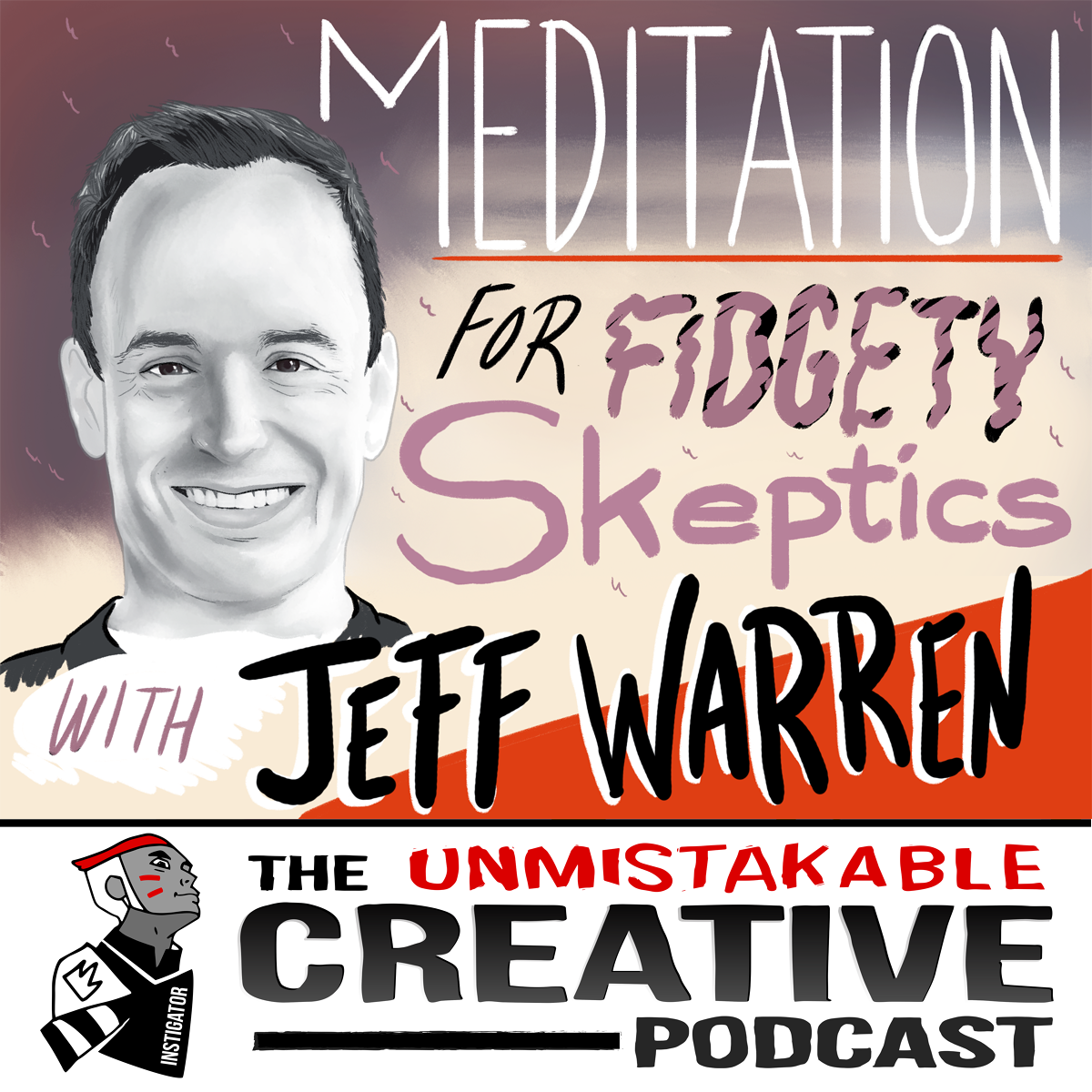
From the Unmistakable Creative podcast: “Meditation can accomplish many things for many different people, and Jeff Warren has experienced that firsthand. Despite having attention issues, Jeff has been able to use meditation effectively and has studied it and its affects on people for years”.

From the Unmistakable Creative podcast: “Meditation can accomplish many things for many different people, and Jeff Warren has experienced that firsthand. Despite having attention issues, Jeff has been able to use meditation effectively and has studied it and its affects on people for years. Hear his theories on meditation, how it’s most effective, and much more in our latest episode!”

More HERE.