
This article originally appeared in the July 2012 issue of Reader’s Digest
 Not three metres from where I’m standing on the starboard side of the sailboat, six very large female sperm whales are doing something few humans have ever witnessed.
The captain of our 40-foot cutter is Dalhousie University biologist Hal Whitehead, one of the pre-eminent experts on sperm whales. It’s mid-afternoon on a sunny day in Mexico’s Gulf of California, a 1,000-kilometre-long body of water famous for its biodiversity. The gulf’s strong tides create a cool upwelling of nutrients that support countless species of marine life, such as snappers, sardines and sharks, as well as that fierce mass of tentacles known as the Humboldt squid. Sperm whales hunt these squid year-round – they dive kilometres under the surface, pinpoint the squid with their sonar and snap them into their large and toothy grins.
For the past five days, Whitehead and four crew members-including two Ph.D. students named Armando Manolo Ãlvarez Torres and Catalina Gomez-have been shadowing the sperm whales around the clock. They track their underwater echolocation pings on the hydrophone by night, and observe and photograph the animals by day. In many ways Whitehead’s approach is that of an old-fashioned behavioural scientist. While younger whale researchers tend to collect data using implants and satellite tracking, Whitehead still prefers following whales in person. By watching who spends time with whom doing what, he can extract insights about their social structure.
Until now, the whale behaviour on display during our trip has been pretty basic: They disappeared into the deep and-invisible to us-hunted. A bushy waterspout, often spotted from the crow’s nest, announced their return to the surface. Family units of half a dozen or so bobbed at the surface of the water, re-oxygenating their blood and preparing for the next dive.
But on rare occasions the whales did something else: They socialized. Another way of saying this is they squirmed all over one another like a business of monster-size aquatic ferrets. “Whoa,” says Gomez, as the water in front of her churns with activity. One of the whales rolls onto her side-we can see the tender pink of her jaw, surprisingly slight and narrow against her large proboscis. Another whale rolls over her, twisting as she moves, while a third pokes her nose vertically out of the water, as if sniffing the air, before undulating sharply, bunching her back as she slides down and into the other bodies. The high-powered field camera whirls as Gomez shoots photo after photo while another crew member furiously fills out the behavioural log in the day’s workbook.
Whitehead calls such socializing the “bonding glue” for sperm-whale society. But we’re also being shown a window into his most astonishing proposition: Sperm whales have distinct cultures. Each clan, he argues, is unique in almost every way: feeding, migration patterns, child-care preferences, rates of reproduction. Sperm whales also speak different dialects. In addition to their echolocation clicks, they produce unique sequences of clicks called “codas,” which change from clan to clan-think of the variations, say, between Sicilian and Venetian-and are likely a declaration of group identity.
“These aren’t genetic differences,” says Whitehead. “They’re learned.” What distinguishes whales-along with chimps, elephants and perhaps some birds-is the fact that the things they learn persist through time. They seem to be passed down from generation to generation until they form part of the distinct identity of the clan.
Whitehead’s evidence adds a whole new dimension to the way we think about protecting whales. It tells us that if humans break up a group of sperm whales or killer whales or dolphins, we are destroying not just individual lives or a population of animals; we are also destroying a unique dialect, a hunting strategy, a social tradition-an ancient, living culture. “You have to understand,” Whitehead says, “until a few hundred thousand years ago most of the culture was in the ocean. Certainly the most sophisticated cultures on Earth were whales and dolphins, until the strange bipedal hominid evolved.”
When Whitehead and his colleague Luke Rendall published their findings in a 2001 special issue of the influential journal Behavioral and Brain Sciences, a few scientific commentators were critical, calling the claims of culture “weak” and “overblown.” Others found the evidence convincing, piecing it together with new research into cetacean cognition that continued through the decade.
It all came to a head this past February in Vancouver, at the annual meeting of the American Association for the Advancement of Science-the world’s largest gathering of scientists-when a small group of scientists and ethicists presented what they hoped would be a paradigm-changing proposal to a packed room: “The Declaration of Rights for Cetaceans.”
“We affirm,” reads the declaration, “that all cetaceans as persons have the right to life, liberty and well-being.” They have the right, the declaration continues, not to be slaughtered, not to be held in captivity, not to be owned or exploited or removed from their environment. The declaration sparked national and international coverage, most of it positive, some critical and some quizzical. “The important thing,” says one of the authors, Atlanta-based Emory University neurobiologist Lori Marino, “is that people are taking it seriously.”
The declaration is, of course, non-binding, so the real test will be whether the group can get the project endorsed legally. They hope to bring the declaration before the UN. As part of another effort, Marino and some of the signatories are also working with an organization called the Nonhuman Rights Project, which is preparing to litigate its first cases and break through the legal wall that currently separates humans from nonhumans. “We want to argue for whale common-law status-to actually use a dolphin or whale as a plaintiff,” says Marino. “We think we can find a jurisdiction where a judge would be open to hearing this. The science is on our side.”
The key claim is that whales and dolphins are entitled to that privileged human status known as personhood. “Humans are considered persons because they have a certain set of characteristics,” says Marino. “They are self-aware, intelligent, complex, autonomous, cultured and so on. If we accept that definition-and versions of this are used around the world in constitutions and other legislation-then the latest science is telling us that cetaceans also qualify. They are, therefore, nonhuman persons.”
Whales, it seems, are having their civil-rights moment. But is the science behind the declaration’s claims sound? And if so, what are the legal and ethical implications of extending personhood to cetaceans? What would a Cetacean Nation even look like?
A few hundred years ago, whales were feared-the stuff of myth and legend. Artist engravings from the 16th century depict great fanged monsters with wings at their ears and horns along their belly. This began to change in the 18th century with the rise of whaling. European and American sailors came back with vivid tales of hardship and struggle. At the centre of their stories was the mighty sperm whale-scourge of the South Seas-who overturned the whaling boats and dragged harpooners to their deaths. From source material like this, Herman Melville spun his great American literature epic.
The first observations of whales came from whaler naturalists, who tagged along on hunting expeditions and kept extensive notes. In 1939, Thomas Beale remarked on the strong sociality of female sperm whales. He was one of the few naturalists who characterized sperm whales as actually being quite gentle (“timid and inoffensive,” in his words). But such accounts were rare. For the most part, the whale was seen as a moving field of blubber, which could be melted for candle wax, soap and, most precious of all, oil. The whale kick-started civilization’s first oil addiction, a nonrenewable resource that fired the industrial revolution and was exploited almost to extinction.
Through the late 19th century, whaling technologies improved greatly and hundreds of thousands of whales were “harvested” a year, leading to a crash in their global numbers. The population of blue whales in the South Seas, for example, went from 350,000 at the turn of the 20th century to just over 2,000 today. Sperm whales, prized for their precious spermaceti oil-the bright, sweet-smelling candles produced from the oil were luxury items-somehow fared considerably better. Their total population is thought to have dropped from over a million to a third of that. Whales were described in terms of “units” -a mechanization of life that was reflected in the dominant scientific view of animals at the time, known as behaviourism, which considered all animals to be stimulus-response machines devoid of inner life.
By the middle of the 20th century, all of this started to change. Biologists began to show up at meetings of the newly established International Whaling Commission (IWC), warning that whales were on the brink of extinction. In the public imagination, whales shifted from Moby Dick to Jacques Cousteau’s gentle giants. The hyper-intrepid dolphin Flipper entertained millions of television viewers during the late ‘60s, while the haunting Songs of the Humpback Whale, released in 1970, became a smash hit for Capitol Records.
The most influential, and polarizing, figure in this new reassessment was a brilliant medical doctor and neurophysiologist named John Lilly. One of the first scientists to promote dolphin problem-solving abilities, Lilly was also a natural showman who, among other stunts, taught dolphins to mimic high-pitched versions of English-language phrases.
The media loved it. Lilly’s books were bestsellers and inspired a generation of future marine biologists. Buoyed by his research data and well-received scientific papers, he began making bold claims. “Individual dolphins and whales,” Lilly wrote, “are to be given the legal rights of human individuals.” Research into cetacean communication, he argued, was a matter of importance to all of human civilization. “We must learn their needs, their ethics, their philosophy,” he wrote. “The extraterrestrials are here – in the sea.”
Lilly’s vivid depiction of dolphins and whales as intelligent, peace-loving ETs was exactly what the youth wanted to hear. The Save the Whales movement was born. Canadian naturalist Farley Mowat’s 1972 A Whale for the Killing helped to rouse public outrage, and Greenpeace-also Canadian-began sending out inflatable Zodiacs between whalers and their prey. In 1986, after years of heated debate, a moratorium on commercial whaling was passed, respected by all member countries in the IWC except Norway, Iceland and Japan, who take advantage of loopholes in the IWC treaty in order to hunt thousands of whales a year.
Today, although some whale populations have begun to recover, the danger is far from over. Seven of the 13 species of great whales remain endangered, and several populations-the Western Northern Pacific grey whale, the Western North Atlantic whale, and the Antarctic blue whale-have only a few hundred remaining. In addition, over 300,000 cetaceans are killed a year in ship collisions and fisheries “bycatch.” What’s more, the IWC treaty does not apply directly to other small whales and dolphins; over 20,000 dolphins and porpoises are killed annually off the coast of Japan alone, including in the shallow coves of Taiji, made infamous in the recent Academy Award-winning documentary The Cove.
According to Marino, a recognition of whale personhood and rights could pressure the IWC to close the remaining loopholes and make it far more difficult for any country to slaughter cetaceans. It might also end dolphin and whale captivity, a challenge for SeaWorld and other aquariums, but a boon for the rapidly expanding global whale-watching industry, which rakes in more than two billion tourist dollars a year and employs more than 13,000 people.
But whale personhood also represents the latest revolution in human sensitivity. For 50 years the idea of whale consciousness has waited for a crossover moment-to go from a fringe belief passionately held by the few to an idea accepted by many. A number of cetacean researchers-declaration in hand-believe that moment has finally come.
Back on the boat, the sperm whales surge towards each other. Before our trip, Whitehead showed me underwater footage of sperm whales socializing, and it was spellbinding. The sensuality of their movements as they slowly rolled and pivoted, scraping their long serrated spines along one another’s pale bellies. The way they sent pulses of sounds into one another’s sides. The scene seemed suffused with a mutual attentiveness and care that I found moving.
Despite not being able to locate the seat of consciousness in the animal brain – something true for humans as well – most scientists no longer ask whether animals have inner experiences. Some degree of sentience is considered self-evident. For neuroscientist Jaak Panksepp, one of the world’s leading experts on the neural origins of mind and emotion, “the denial of consciousness in animals is as improbable as the pre-scientific anthropocentric view that the sun revolves around the Earth.”
But what do we mean by “consciousness”? At its most basic, consciousness can simply mean being aware of your surroundings. By this definition, of course, nearly every animal would have some form of awareness. Many different species perform a whole range of social actions, including co-operative behaviours and maternal care. Bees show complex activities – but does that mean they’re conscious? Quite possibly, yes. The question now is no longer whether animals have minds, but what kind of minds.
Scientists now understand the mind as a much larger phenomenon, with many different species’ expressions. Humans and animals are not separated by some yawning chasm – the fact that we share basic brain structures suggests we might also share similar cognitive structures – like thousands of different operating systems coded to run the same apps. Cetaceans have been a big part of this story, in part because of Whitehead’s findings, but also because of the experiments of dedicated researchers such as the University of Hawaii’s Lou Herman, who has proved that dolphins are capable of complex problem solving, demonstrating prodigious feats of learning, memory and creativity. One well-known anecdote involves a clever aquarium dolphin who was rewarded by his trainers for retrieving one piece of garbage after another. It turns out that, in order to maximize his fishy rewards, the dolphin had stashed an entire newspaper at the bottom of the tank and was very deliberately tearing off one small piece at a time.
But the most game-changing research may be the reappraisal of the whale brain currently under way. Marino has spent 20 years studying the whale brain’s structure and evolution, and found that it’s not only large (it’s second only to a human’s in its brain-to-body ratio) but also contains many braided cell structures and areas of dense connectivity. The term for this is “convoluted” – the cortex folds in on itself to increase its surface area inside the skull, thus giving the brain its ridged appearance (the brains of less intelligent animals are much smoother). What’s more, the history of the whale brain has been very different from those of primates and other mammals. Thirty-five million years ago it began arranging its parts into an utterly unique functional layout and structure. This achievement, says Marino, represents “an alternative evolutionary route to complex intelligence.”
The most intriguing part of the whale brain for Marino is the limbic system, which, in mammals, handles the processing of emotions. In some respects, she found this part of the whale brain is actually more convoluted than our own. In fact it’s so large it erupts into the cortex in the form of an extra paralimbic lobe. The location of the lobe suggests it is involved in a unique mash-up between emotional and cognitive thinking, perhaps some mix of social communication and self-awareness that we do not currently understand.
“Whales are arguably the most socially connected, communicative and coordinated mammals on the planet, including humans,” says Marino. “Killer whales, for instance, do not kill or even seriously harm one another in the wild, despite the fact that there is competition for prey and mates and there are disagreements. Their social rules prohibit real violence, and they seem to have worked out a way to peacefully manage the partitioning of resources among different groups. That is something we humans haven’t done yet.”
Whitehead points down: Two of the whales have suddenly become curious about us. Torres, intent on recording the codas, unspooled a long hydrophone into the water. The whales begin echolocating furiously on the blue cable, which trails behind the boat. I can feel the echolocation pings roll through the hull below me as I pull in the line, concerned the whales might bite the cord, as happened on Whitehead’s last trip. One of the whales follows the hydrophone in. I feel as if I’m fishing for giants. Finally, she pivots onto her side and fixes me with a large watery eye before rolling back to her family.
Whitehead, Marino and a few other whale scientists believe that echolocation – which Whitehead calls the “world’s most powerful imaging device” – might play a central role in whales’ social sophistication. It is possible that the faculty is used like an ultrasound to see inside bodies. “The sonar system may see, in great detail, the internal organs of all the other members of the group,” says Whitehead. “So there’s no hiding what one has eaten, whether one’s sexually receptive, whether one’s pregnant, whether one’s sick. Presumably, this changes social life a lot.”
It doesn’t stop there. An enormous amount of information is contained in the body: accelerated beating of the heart, tightness in the diaphragm, tension in the muscles-all of these registers of information may well be processed by the whale’s huge associative cortexes at lightning-fast speed. And not in isolation-most astounding of all is the possibility that all of this may be shared. There is evidence to suggest that dolphins and sperm whales can “eavesdrop” on another’s returning echoes, an ability akin to seeing through another’s eyes. Thus a group of widely dispersed whales may in some sense be part of a single sensory loop, sensitive to every twitch and shudder in the wide phenomenal world.
One of the larger females has begun to “spy hop” – rising up vertically out of the water like a thick periscope, exposing her eyes to the surface. I have the sense that I’m being stared at by another form of intelligence. It’s both thrilling and a little disconcerting, as though I’m being asked to partake in an exchange I haven’t really prepared for.
Some of the critics of the declaration certainly feel this way. National Post columnist and policy analyst Tasha Kheiriddin was quick to point out that in order for an animal to have rights, it must be part of a social contract, something impossible between animals and humans. “An animal owns no property. It cannot be taxed. It bears no responsibility, legal or otherwise for its actions: You cannot sue a dolphin if it bites you or wrecks your boat.”
Marino says there are other ways to look at it. “We don’t expect human infants to have responsibilities,” she says, “yet we still consider them people.” Ultimately, Marino argues, the declaration becomes pretty hard to dismiss if you stick with basic rights. “We are not saying that dolphins should vote or go to school – obviously this is preposterous. What we are saying is that the rights of a species should be based on their critical needs. In the case of whales, they should have the right not to be killed and tortured and confined, the right to live free in their natural environment. This is very basic stuff.”
Marino’s vision for a Cetacean Nation is, at first blush, that of a conservationist. But as I watch the whales I realize there’s also something new in the works here, something that has to do with our own minds, not just whale minds. We’ve always looked to the stars for signs of intelligent life. Now we’re waking up to the idea that such life exists right here. But the facts as we currently understand them – for 35 million years whales have had the largest brains and the most complex cultures on the planet – can’t really tell us what kind of mind we are dealing with. Where, for example, so many of our resources are directed towards manipulating objects and ideas, whales’ emotional and cognitive resources seem to be directed socially, at one another. They have no hands to manipulate the world. But they have brains to feel it, in a way we do not and cannot fully understand.
And yet, for all the exotic otherness of the whale mind, it’s equally true that there are elements that we can know and understand. As any pet owner will attest, we can often tell when an animal is angry or loving or even calculating, because we share those qualities. I can relate to the sperm whales’ need for physical intimacy, to their loyalty to one another, to their curiosity. And these are just the visible behaviours. The science suggests other shared qualities: a capacity for culture, communication and creative problem solving. What you begin to realize about animal minds is that, when we compare ours to theirs, there’s always something distinct and something shared; this ratio simply shifts in relation to the species in question.
So the common core we share with a bacterium is far narrower than that we share with a whale, which in turn is perhaps narrower than that we share with our close cousin the chimp. In a sense the human-to-animal mind question may simply be an exaggerated version of the human-to-human mind question: We can never entirely know another person’s experience – all the more so if that person was raised in a different culture – but there are vast areas of overlap that can, with science and empathy and imagination, be expanded.
What is a person? A being, certainly. But personhood is also a quality that emerges from how we relate to one another. When we deem another entity a “person” we recognize that there’s another point of view present, one with its own internal coherence and integrity. Whatever happens on the legal front in the years to come, the question of animal personhood is also a personal one. It will be answered differently by each of us. The true promise of the Cetacean Nation will only be realized to the extent that we, as a species, can recognize we’re surrounded by a rainbow of exotic cultures and narratives. We’re invited to be participating members in the community of nature, connected as though by invisible lines of echolocation to all these other “persons” on our planetary home.
As for the sperm whales, it’s enough, for now, just to watch them. Gradually, they stop playing and begin to drift away from the boat. Then, as if cued by some invisible signal, they roll their broad backs and salute the air with their chiseled flukes. Six clear watermarks float in their wake.


 From the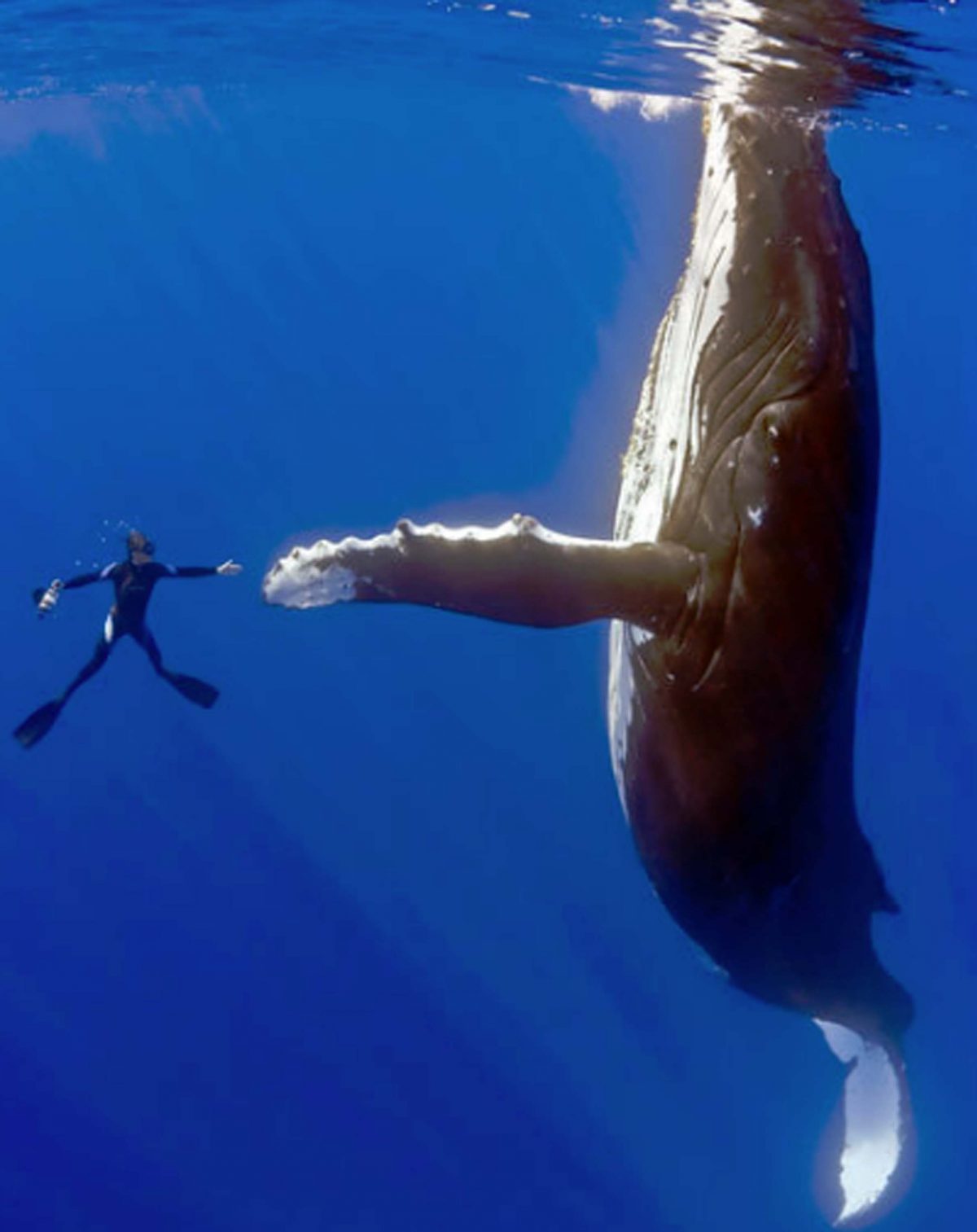

 My iPhone is like a little sensing organism. It hears (microphone), sees (camera), feels (touch screen), balances (gyroscope), and is self-aware enough to know both its speed (accelerometer) and position (GPS). In these different ways my iPhone senses the external world and, via different apps, generates an appropriate response. This is not a bad description of a crude mammalian sensory-motor system.
 Whales are just for starters. We could have apps for dogs and cats, calibrated to their particular visual and auditory systems – specialized colour spectrum, amplified sounds, higher frequencies. Imagine the potential market, given the pet-owner demographic: “Look dear, this is how Dexter sees the world.” Like a dog sniffing a pole, our iPhones could have chemical sensors that detect olfactory signatures and translates them into an undulating tapestry of indexed and colored airflows.
 Although some of this functionality is out of reach at the moment, the technology is getting cheaper and faster and more portable (and responsive) by the day. As it does so, expect some radical sensory extension: tools to visualize the chemical world of plant information exchange, the electrical fields of amphibians, the fluxing and shifting magnetic field of the planet itself – the list goes on and on. Put three artists and three biologists and three ecologists in a room and you’d have fifty cool Animal-Empathy App ideas in under an hour. (My friend Marni suggests The Kafka App: “the alarm that wakes you up in the mind of a cockroach.”)
 Keeping pace with our crimes, the human capacity for empathy continues to expand. Over the past two hundred years, in part via the printed word (that first generation of perspective-expanding technology), our circle of empathy has moved far beyond the small ruling world of white male property owners. Lately we’ve seen a new cultural focus, in works like The Curious Incident of the Dog in the Night, on stories that dramatize the interior landscape of mental illness, for instance – the world of autistics, schizophrenics and depressives. We go to movies like Melancholia, or Spider. And non-human nature will be next. There is nowhere else to go.
 Thirty years ago, if you mentioned animal consciousness at a psychology conference, you’d risk getting cattle-prodded by some beady-eyed Behaviorist. Animals were mostly regarded as stimulus-response machines, devoid of inner life.

 The primatologist Frans de Waal says those who reject this obvious insight are in “
 This last point is important. The ratio of one to many, of the shared to the private – it isn’t static. There’s a malleable area between the two that can be expanded. Like anything else, relating to another being’s perspective is a practice.


 Welcome to the
 A better answer is it matters for understanding the nature of mind. If we look at nonduality in its most general form – the lived recognition that each of us is part of a much larger existential process – then many argue this where civilization’s great spiritual practices – meditation, prayer, koans, ecstatic dance – all lead.
 Three Perspectives on the Absolute
 A Rant
 I recently wrote about
  These practices are about deliberately modifying the self. They’re about learning new skills, and building supportive habits, and generally staying responsive and awake to the changing world.
 Building Jigsaw Puzzles I recently read a book by Daniel Levitin called
  Learning to Paint I started four years ago with no experience since grade school. Like meditation, some days it’s easier and some days it’s harder, but it’s always rewarding. At best, it’s a mental cleanse with my mind getting a vacation from it’s more typical uptight, verbal existence. At these times, I swear I can feel the shift from doing to being. It’s also pretty cool that sometimes I end up with something to hang on my wall or give to someone. I think this is helping me learn to be a more balanced person, to trust my intuition, and to embrace my creativity. – Robin Westacott
 Drinking an Entire Quart of Water When I worked in restaurants as a chef, which was terribly exhausting, I’d get reactionary to every tiny issue that came my way. My breath and focus would spiral uncontrollably. Then I figured out my water practice. I’d put the [quart] container to my lips and not pull it away until the container was done. This forced me to focus on my breath, like someone that was snorkeling. One breath in, through the nose. One breath out, through the nose. I eventually learned to focus my gaze on the water for the whole practice, instead of the stimuli coming from the kitchen. Now when I do this practice, I focus on Bruce Lee’s quote “Be the water.” – Rob Velazquez
 Listening to Records I’ve always been a huge fan of music and vinyl. Since Corona I’ve been taking time to listen to old and new records, sitting in front of the record player and paying a lot of attention to the music. Just like I used to as a kid. – Cinderella Baksa-Soós
 Napping The one thing I do extremely deliberately – when my schedule allows it – is nap. I don’t mean a quick power nap in the middle of the day, but a proper 2 hour nap in my PJ’s. This practice helped me stay on track with writing my PhD and it has helped me during the current lockdown. It is the single biggest reason why I’m more productive with work activities than I would be on a normal day at the University. Taking naps helps me manage migraines, work more hours in a day (productively — without drifting off to Facebook), and it gives me more energy for workouts. I could talk about napping for hours. – Petra
 Walking in the Woods When I walk through the woods I feel “embraced,” “contained.” I feel safe and protected by the trees … I never feel alone, although I am almost always by myself. I am calm. I smell the earth, hear (and sometimes talk to) the birds. I look for new shoots, trees budding. In this act, I am lifted out of whatever anxieties I came into the woods with. I may not solve a bunch of problems, but I can at least accord myself some time in the day where I don’t have to ruminate or worry. And this calm builds on itself. It is strength. – Heidi K. Wiedemann
 Protesting Last week, I attended a protest for racial justice. I marched with thousands of others; we raised our signs and our voices together in support of Black lives and to oppose police brutality. Our common purpose and sense of community was strong, and I felt the connection in my body as I marched. The protest finished outside our city’s courthouse, where we continued to stand together. We listened to Black leaders share their stories and hopes for the future. Towards the end, a Black woman got on the microphone and told the white people (like me) to walk over to a Black person and face them. I turned towards a Black man standing behind me. As the woman instructed, I looked into his eyes, paused, and said “You are my brother.” He paused, looked into my eyes, and said, “You are my sister.” My whole being filled with joy; our shared humanity became a felt sense. After some silence, both of us still looking at each other, he said “Thank you for being here.” I said “There’s nowhere else I’d rather be.” There was such truth and clarity in that moment. I realized: that is the practice. – Brooke Thomas
 Making Documentary Films Sometimes my
  Sewing Masks I’ve turned my tiny garage in California into a sewing studio and I’ve been meditatively sewing PPE masks to donate to farm workers. I have sewn and donated more than 200 face masks to vulnerable communities around the Bay Area and also just sent a batch of face masks to the Northern Diné Navajo reserve in New Mexico. Making masks for others provides me with an extraordinary practice of self-care and the feeling of fulfillment that I’m helping others who need it the most. – Michelle Jones
 Improving Teamwork I help teams diagnose what’s preventing them from doing their best work, and then I prescribe simple remedies and rituals and practices. Some of these practices help colleagues solve tough problems, some create trust and psychological safety, and some clear up misunderstandings and conflict. I love doing this work. When it clicks it feels like alchemy, like 1 + 1 + 1 = 3.5. We get bigger together. – Matt Thompson
 Petting Cats My practice is petting my cats with such love that my body and mind shift to a noticeable healing mode. The singular attention on my pets inspires heightened awareness naturally, because the love for them makes it easy. As I do this, I’m effortlessly cultivating skills of focus, kindness, and clarity for other parts of my life, and I feel more open to whatever the day brings. That “practice love” for my cats spills over to my world. All this is more possible because of the scaffolding of sitting meditation skills and experiences. – Jill Badonsky
 Searching for Beauty I call it “searching for beauty”. Often it involves looking up and noticing details, like the composition of branches against a sky, or the movement of leaves or the colours in the sky or shapes in the clouds. At other times, it means looking deeply, which involves stopping and examining the pattern of bark or the interior of a flower or the striations in broken wood on a fallen tree or the whorl of grasses on the earth. Often I capture the beauty with a photo. Most of my searches for beauty take place while walking my Dalmatian! – Toozie
 Exploring Geneaology I practice researching my family history at least once a week, often every day. The process of researching my ancestors and learning about their lives grounds me and reassures me that this moment that I’ve been given is to be treasured and appreciated. – Sherri Taggart Ahmadzadeh
  Just Looking I’ve made it a daily practice, often several times a day, to simply “see out” anytime I am walking outside, whether it be in nature, or walking on Bloor Street, as I do frequently. Seeing the sky and clouds is usually the trigger. I take a pause to pay close attention to the whole visual field, as widely as possible and to repeat a Ram Dass mantra: “I am loving awareness” many times. And I look momentarily for who it is that is seeing. Often I seem to meld into the visual field. I find it consistently awe inspiring and feel grateful for being part of it all. It helps me answer Ramana Maharshi’s basic question: “Who am I?” – Bob
 Listening to the Wind Every night I go outside before bed, sometimes I have so many clothes on I wobble out. I sit in a deck chair and make sure all the lights are out. I live in the country, so it can get pretty dark. I sit for at least 30 minutes and listen to the wind. It makes me focus on something transient to impress how ‘a moment’ feels. The wind at first seems very simple. But the more you listen, you can feel how multidimensional it is … volume, speed, direction … what’s in it, rain or leaves, where it’s going, up into the universe, with my thoughts, or maybe skimming the surface of the land, loud with other beings. It has life. It is life. I breathe the wind. When I started this practice I was just aiming to sit still, then it developed to sounds around me, and after a few months … hours would pass! I am connected to life. – Pam
 PS – The Practice of Mutual Aid. From Jia Tolentino, in
 From the CBC radio Now or Never show: “Even now, with many of us stuck at home, carving out the time or finding the space to slow down can feel impossible.
 The narrative is me acting as a guinea pig for various scientific and quasi-scientific experimentation, from sleep lab analysis, to
 I made
  “In The Head Trip, Jeff Warren takes readers on an audacious, enchanting, and often hilarious journey into the slippery nature of human consciousness, from deep slumber to lofty states of enlightenment. This book will blow your mind.” -Sandra Blakeslee, co-author of On Intelligence
 “The best contemporary book on the psychology of consciousness.” – Andre Kukla, University of Toronto prof, author of Mental Traps.


 “As readable and fun as a novel, yet accurate and up-to-date, The Head Trip is about your most precious possession – your consciousness – and the fascinating states it goes through.” -Charles T. Tart, author of Altered States of Consciousness
 April 2013 talk with Erik Davis and co-host Maja D’Aoust for their Progressive Radio Network show “Expanding Mind.” Touches on the experience of meditation, the richness of spiritual practice, the relationship between insight and ethics, the mystery of human enlightenment and – to keep it modest – science and the nature of reality.
 From a talk at the 2012 Dreamers, Renegades, Visionaries festival in Toronto. About how technology affects the mind, and how some developers are thinking about ways of integrating principles of mindfulness and mental health directly into the hardware and software of our smartphones, operating systems and other interfaces.



 Lisa Zimmerman is a Psychotherapist, supervisor, teacher and meditation and donut enthusiast in private practice in Ottawa. She also works with an Indigenous organization delivering anti-bias trainings all over the country and specialists in trauma and addiction treatment. She is Jeff’s friend and has no website of her own, hence her presence here!
 From the